9 min to read
Why Build a Software Factory? The Case for Systematic Development
The ROI, hidden costs, and why top teams invest in this
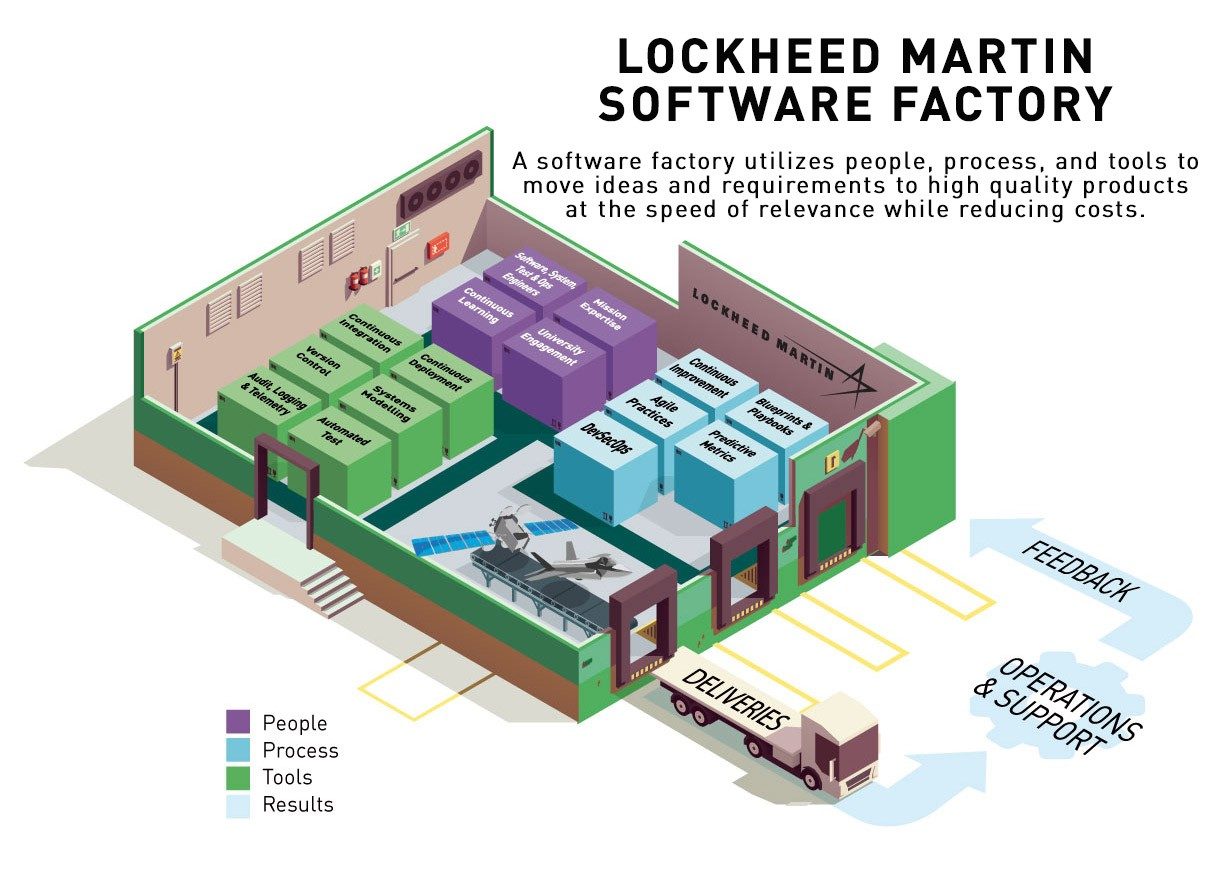
Image credit: Lockheed Martin
The Friction of Manual Development
Without a factory, developers spend 30-40% of project time on structural decisions rather than solving the actual problem.
TL;DR — Software factories pay for themselves within 2-3 months and compound from there. A 5-person team building 4-5 projects/year saves 475-892 hours in Year 1 alone — worth $71,250-$133,800 at typical developer rates. The five benefits stack: faster velocity, fewer bugs, 3x faster onboarding, consistent quality, and team scaling without chaos.
Before diving into why factories matter, let’s acknowledge the costs of not having one.
Every developer on a typical team faces these friction points:
Project Setup (2-4 hours)
- “Where do I put this code?”
- “What’s the folder structure?”
- “Do we use Redux or Context?”
- “How do we handle authentication?”
- “What database schema do we follow?”
Coding Time (Decision Overhead)
- Spending 30 minutes on a naming convention
- Rewriting a pattern that was already solved 3 projects ago
- Debating error handling approaches mid-PR
- Copying boilerplate from an old project (and copying bugs too)
Code Review (15-30% of cycle time)
- “This doesn’t follow our conventions”
- “You missed a test case”
- “Security check: input validation?”
- “Can this be extracted into a util?”
Deployment
- Manual environment setup
- Environment variable management
- Deployment scripts that differ per project
- Incidents because staging doesn’t match production
Onboarding (1-4 weeks to productivity)
- New developers learn by reading code, not following guides
- Tribal knowledge held by 1-2 senior devs
- “How do we do X around here?” asked repeatedly
- No consistent place to find answers
Does the Math Actually Work? The Factory ROI
The 80-hour factory investment breaks even within the first project cycle and compounds from there.
Let’s calculate the ROI for a 5-person team over one year.
Baseline: Without a Software Factory
Project A - 3 weeks
- Setup: 3 days (12 hours team time) = 60 hours
- Development: 10 days = 400 hours
- Code review friction: +20% overhead = 80 hours
- Total: 540 hours
Project B - 3 weeks (team repeats decisions)
- Setup: 2 days (recreating solutions) = 80 hours
- Development: 10 days = 400 hours
- Code review friction: +20% = 80 hours
- Total: 560 hours
Year 1 baseline for 5 developers
- 4-5 projects × 560 hours = 2,240-2,800 hours
- Velocity: ~8-10 features per project
With a Software Factory
One-time investment: 2 weeks
- Design orchestrator: 1 week
- Build templates: 3-4 days
- Encode conventions: 2-3 days
- Documentation: 1-2 days
- Total investment: 80 hours (one senior dev)
Project A (using factory)
- Setup: 30 minutes (scaffold command) = 2 hours
- Development: 10 days = 400 hours
- Code review: -30% friction (conventions are automatic) = 56 hours
- Total: 458 hours
Project B (team repeats patterns, not decisions)
- Setup: 15 minutes = 1 hour
- Development: 10 days = 400 hours
- Code review: -30% = 56 hours
- Total: 457 hours
Year 1 with factory (5 developers)
- Upfront: 80 hours (one dev, one week)
- 4-5 projects × 457 hours = 1,828-2,285 hours
- Velocity: ~12-15 features per project (+40-50%)
- Total: 1,908-2,365 hours (savings: 475-892 hours)
The Compounding Effect
These numbers get better over time:
- Year 1: 475-892 hours saved = 1-2 developers worth of time
- Year 2: 950-1,784 hours saved (factory refinements reduce friction more)
- Year 3: 1,400+ hours saved (new team members adopt factory faster)
At $150/hour fully-loaded cost, Year 1 alone saves $71,250-$133,800.
What Concrete Benefits Does a Factory Deliver?
Each benefit compounds independently — together they create multiplicative, not additive, productivity gains.
1. Velocity (Speed to Ship)
Factories accelerate shipping through:
- Reduced setup time (30 min vs. 3 days per project)
- Automatic scaffolding (code generation eliminates boilerplate)
- Fewer decisions (conventions pre-decided)
- Faster code review (patterns are consistent)
Metric: Projects ship 2-3 weeks faster on average.
2. Quality (Fewer Defects)
Automated checks and consistent patterns reduce bugs:
- Automated tests (generated test structure = fewer untested code paths)
- Linting & type checking (enforced before merge)
- Security scanning (vulnerabilities caught pre-deployment)
- Consistent error handling (bugs are more predictable, easier to fix)
Metric: Post-release defects drop 30-50%.
3. Onboarding (New Developer Productivity)
Without a factory:
- Week 1-2: Understands project structure
- Week 3-4: Knows team conventions
- Week 5-6: Starts contributing meaningfully
- Time to productivity: 4-6 weeks
With a factory:
- Day 1: Scaffold a new feature using factory
- Day 2-3: See patterns in working code
- Week 1-2: Contributing confidently
- Time to productivity: 1-2 weeks (3x faster)
Metric: ROI on factory compounds as team scales—every new hire needs only half the onboarding.
4. Consistency (Reduced Technical Debt)
Without a factory, each project drifts:
- Project A uses Redux, Project B uses Zustand
- Project A has integration tests, Project B has none
- Project A uses PostgreSQL, Project B uses MongoDB
- After 2 years, your codebase is a patchwork
With a factory:
- All projects use the same patterns
- Code is interchangeable across projects
- New developers transfer between projects instantly
- Technical debt is predictable and manageable
Metric: Knowledge transfer time drops from days to hours.
5. Scaling Teams (Team Multiplication)
Without a factory:
- 5 developers ship X features/quarter
- Hire 5 more developers
- Chaos: new team repeats old mistakes, slows down existing team
- Output grows to 1.2X (not 2X) because onboarding and confusion cost time
With a factory:
- 5 developers + factory ship X+30% features/quarter
- Hire 5 more developers
- New team follows factory, productivity ramps in 2 weeks
- Output grows to 1.9X (closer to 2X) because factory handles knowledge transfer
Metric: Productivity per developer stays consistent as team grows instead of declining.
What Do Top Companies Show About Factory Investment?
Google’s monorepo + Bazel, Netflix’s OSS resilience tools, and Stripe’s SDK generation are all factory investments that scaled to tens of thousands of engineers.
Google’s Factory Mindset
Google doesn’t have 100,000 engineers all making independent decisions. They have:
- Standardized tooling (Bazel build system)
- Shared libraries (common patterns encapsulated)
- Code review standards (readable, consistent diffs)
- Monorepo conventions (where to put what)
Result: Google engineers can jump between projects and contribute immediately.
Netflix’s Template Approach
Netflix open-sourced tools like Hystrix, Eureka, and Zuul—each is a factory component that other companies can adopt. Internally, Netflix uses these to ensure:
- Resilience patterns are consistent
- Observability is built-in
- Failure modes are predictable
Stripe’s Developer Experience
Stripe is known for excellent developer experience. Behind the scenes:
- Consistent API patterns (every endpoint follows the same structure)
- SDK generation (factory generates language bindings from API spec)
- Comprehensive documentation (generated from canonical source)
Result: Integrating Stripe takes hours instead of days.
What Hidden Costs Accumulate Without a Factory?
As teams grow without a factory, they accumulate:
- Inconsistent codebases (hard to move between projects)
- Duplicate solutions (same problem solved 3 different ways)
- Tribal knowledge (only seniors know how things work)
- Slow onboarding (new developers slow down existing team)
- Preventable bugs (patterns that work aren’t followed)
This is often called accidental complexity — problems created by lack of structure, not inherent to the problem domain.
Factories eliminate accidental complexity.
When Is a Software Factory Actually Worth Building?
Factories have upfront costs. They’re worth building when:
- Team size: 3+ developers (below this, overhead > benefit)
- Project count: 2+ active projects (patterns start repeating)
- Time horizon: 12+ months (break-even takes 2-3 months)
- Problem domain consistency: Same types of problems (API backends, UIs, data pipelines)
If you’re a solo developer building one-off projects? Factories are overkill.
If you’re a team of 5+ building related projects? Factories are essential.
Key Takeaway
Software factories aren’t about automation for its own sake. They’re about compounding productivity gains:
- First project: 10% time savings
- Second project: 20% time savings (patterns are proven)
- Third+ projects: 30-40% time savings (conventions are internalized)
Scale across a team and over time, factories create 30-50% velocity improvements with better quality and faster onboarding.
The investment of 1-2 weeks pays back within a month and keeps compounding.
Frequently Asked Questions
Q: What is the upfront cost to build a software factory?
A: A basic factory takes one senior developer about 1-2 weeks (40-80 hours). This includes conventions documentation, 2-3 project templates, automation scripts, and a CI/CD quality gate pipeline.
Q: How quickly does a factory break even?
A: For a 5-person team running 4-5 projects/year, the 80-hour investment pays back within the first project cycle (typically 4-8 weeks). Compounding savings grow 2x each year as patterns mature.
Q: Do solo developers benefit from building a factory?
A: Yes. A solo developer running 2+ similar projects/year saves 40-60 hours per year from reduced setup overhead and fewer repeated decisions. The investment is smaller (1 week), so break-even is even faster.
Q: What’s the biggest risk of investing in a factory?
A: Over-engineering it. Start minimal — a conventions doc + one template + basic CI pipeline. Add complexity only when you feel the friction of not having it. See Part 3 for the minimal viable factory architecture.
Q: What if my team doesn’t adopt the factory?
A: Adoption depends on showing the metrics. Track setup time before and after, show reduced code review friction, and share the velocity numbers. Teams adopt factories when they feel the benefit, not when they’re told.
Sources and Further Reading
- Accelerate: The Science of Lean Software and DevOps (Forsgren, Humble, Kim) — empirical research on elite software delivery performance
- DORA State of DevOps Report 2023 — annual metrics on deployment frequency, lead time, and change failure rates
- Google’s Engineering Productivity Research — data on how Google measures developer effectiveness
- Stripe Engineering Blog — practical examples of systematic API design at scale
- ThoughtWorks — Building Internal Developer Platforms — enterprise factory patterns
What’s Next
Part 3 dives into the mechanics: How do you actually build a software factory? We’ll cover the five-layer architecture, how to structure each component, and a step-by-step guide to your first working factory.
| Series Progress: 2/7 Complete ✓ | Next: How to Build a Software Factory → |