11 min to read
Real-World Factory Examples: Netflix, Google, Stripe, and Uber
How Tech Giants Built Systematic Development Pipelines (Before AI Agents)
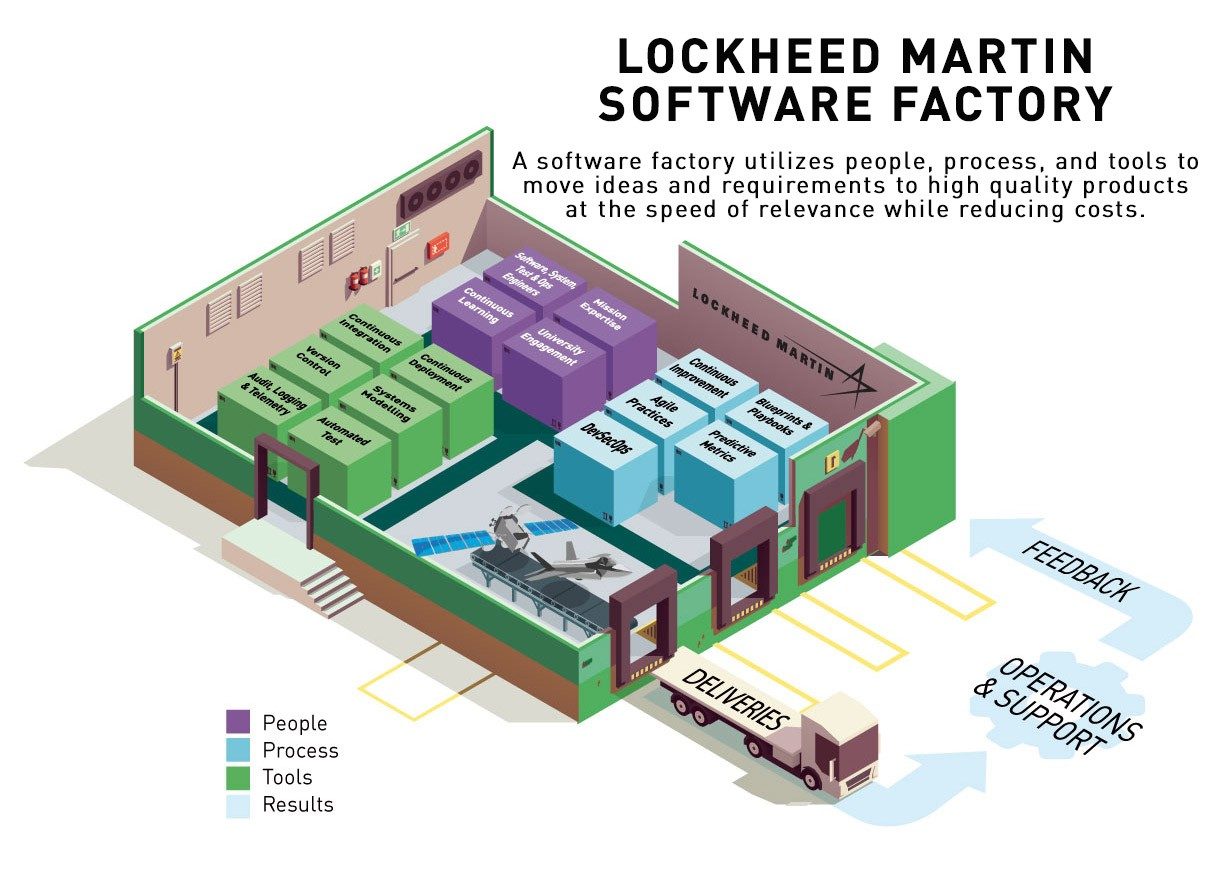
Image credit: Lockheed Martin
Software Factories at Scale: Before AI Agents
TL;DR — Netflix, Google, Stripe, and Uber all built software factories decades before AI agents. Netflix uses Spinnaker (deployment orchestration), Google uses Bazel (build system templates), Stripe uses SDK generation (code templates), and Uber uses Schematization (standardized service patterns). These foundational patterns are the starting point for modern autonomous factories.
Before AI agents, large tech companies built sophisticated software factories using automation, templates, and standardized processes. These patterns are still relevant today and form the foundation for autonomous factories.
Netflix: Spinnaker and Deployment Orchestration
Problem: Deploy the same microservice code to 50+ cloud regions simultaneously while maintaining canary deployments and instant rollback capability.
The Netflix Factory
Spinnaker (open source) is Netflix’s deployment orchestration engine:
Developer commits code
  ↓
[Build Pipeline]
  - Compile service code
  - Run unit tests
  - Build Docker image
  - Push to registry
  ↓
[Deployment Pipeline]
  - Create CloudFormation template
  - Deploy to dev environment
  - Run integration tests
  ✓ If pass: proceed
  ✗ If fail: stop
  ↓
[Canary Deployment]
  - Deploy to 1 server (1% traffic)
  - Monitor for 10 minutes
  ✓ If metrics good: proceed
  ✗ If issues: auto-rollback
  ↓
[Progressive Rollout]
  - 10% servers
  - Monitor 10 minutes
  - 25% servers
  - Monitor 10 minutes
  - 50% servers
  - 100% servers
  ↓
[Monitoring]
  - Watch error rate
  - Watch latency
  - Watch CPU/memory
  - Auto-rollback if issues
Key Innovation: Orchestration
Netflix built orchestration as code:
pipeline:
  name: "Deploy User Service"
  stages:
    - name: "Build"
      type: "build"
      command: "docker build -t user-service:v1.2.3 ."

    - name: "Deploy to Dev"
      type: "deploy"
      target: "dev"
      requires: ["Build"]
      validation: "run-tests"

    - name: "Canary Deploy"
      type: "canary-deploy"
      target: "prod"
      traffic_percentage: 1
      duration_minutes: 10
      rollback_on: ["error_rate > 1%", "latency_p99 > 500ms"]

    - name: "Full Rollout"
      type: "deploy"
      target: "prod"
      traffic_percentage: 100
      requires: ["Canary Deploy"]
Result
- Deployment frequency: 4,000+ deploys per day at Netflix
- MTTR (mean time to recovery): <5 minutes (vs. hours at traditional companies)
- Success rate: 99.98% of deploys don’t cause incidents
- Rollback time: <2 minutes (instant, fully automated)
Google: Bazel and Build System Templates
Problem: Keep a 2+ billion line monorepo building fast, with consistent dependency resolution across 40+ languages and 50,000+ developers.
The Google Factory
Bazel (open source) is Google’s build orchestration system. Instead of each project defining dependencies differently, Bazel defines a single template:
# BUILD file (Bazel template for C++)
cc_library(
  name = "http_client",
  srcs = ["http_client.cc"],
  hdrs = ["http_client.h"],
  deps = [
    "//third_party:openssl",
    "//common:logging"
  ]
)

cc_test(
  name = "http_client_test",
  srcs = ["http_client_test.cc"],
  deps = [":http_client", "//testing:gtest"]
)
The key: Every C++ project looks exactly the same. Every dependency is resolved identically. No surprises.
Templates for Every Language
Google built templates for:
- C++ (compiled, fast)
- Java (JVM, distributed)
- Python (data, ML)
- JavaScript (frontend, Node)
- Go (services, tools)
- Rust (systems)
- Kotlin (Android)
- And 30+ more
Result: Developers never ask “how do I compile X?” The template answers it.
Google’s Automation Pipeline
developer pushes code
  ↓
[Build]
  bazel build //...
  (compiles everything, all languages)
  ↓
[Unit Test]
  bazel test //...
  (runs all unit tests)
  ↓
[Integration Test]
  bazel run //integration:tests
  (tests across service boundaries)
  ↓
[Type Check]
  pytype  (Python)
  tsc     (TypeScript)
  (language-specific type checking)
  ↓
[Lint]
  clang-tidy  (C++)
  checkstyle  (Java)
  pylint      (Python)
  (consistent code standards)
  ↓
[Security Scan]
  OSS scan (vulnerable dependencies)
  SAST scan (code vulnerabilities)
  ↓
[Performance Test]
  benchmarks/profiling
  detect regressions
  ↓
[Code Review]
  (human review at this point)
  ↓
[Merge to Main]
Result
- Build time: ~1 minute for full codebase (2B+ lines)
- Consistency: Same build result every time (no “works on my machine”)
- Parallelization: Builds run on 1000+ machines in parallel
- Dependency conflicts: ~0 (Bazel enforces consistency)
Stripe: SDK Generation Templates
Problem: Keep SDKs for 10+ languages in sync with API changes, automatically generated from one source of truth.
The Stripe Factory
Stripe built SDK generation templates from their OpenAPI spec:
# Single source of truth: openapi.yaml
paths:
  /v1/charges:
    post:
      operationId: createCharge
      parameters:
        - name: amount
          in: query
          type: integer
        - name: currency
          in: query
          type: string
      responses:
        '200':
          schema: Charge

# From this spec, Stripe generates:
# - Python SDK: stripe.Charge.create(amount=100, currency='usd')
# - JavaScript SDK: stripe.charges.create({amount: 100, currency: 'usd'})
# - Go SDK: stripe.NewCharge().SetAmount(100).SetCurrency("usd").Create()
# - Ruby SDK: Stripe::Charge.create(amount: 100, currency: 'usd')
# - All with identical logic, identical error handling, identical tests
The Template Library
For each language:
python-sdk-template/
├── stripe/           # Generated client classes
├── tests/            # Generated test suite
├── docs/             # Generated documentation
├── examples/         # Generated usage examples
├── setup.py          # Generated package config
└── __init__.py       # Generated module exports
Generator runs daily — API change → automatic SDK update → all SDKs in sync.
Result
- SDK consistency: All SDKs have identical methods, identical behavior
- Bug consistency: Fix once, fix everywhere
- Onboarding time: Same for Python and Go developers (patterns identical)
- Maintenance cost: Zero manual SDK maintenance
Uber: Schematization and Service Standards
Problem: 1000+ microservices built by hundreds of teams with different patterns, different dependencies, different deployment strategies.
The Uber Factory
Uber built Schematization — a standardized service template:
# Every Uber service follows this schema
UberService:
  name: users
  language: Go

  # Every service has the same database access pattern
  databases:
    - name: users_db
      type: PostgreSQL
      migrations: auto
      read_replicas: 3

  # Every service has the same API pattern
  apis:
    - path: /users/{id}
      method: GET
      handler: GetUserHandler
      auth: required
      rate_limit: 1000/min

  # Every service has the same monitoring
  monitoring:
    error_rate_alert: > 1%
    latency_alert: p99 > 500ms
    disk_space_alert: > 80%

  # Every service deploys the same way
  deployment:
    environment: docker
    orchestration: kubernetes
    canary_percentage: 5
    canary_duration_minutes: 15
The Template Enforcer
Uber built tools that enforce the schema:
# Automatic validation on every PR
def validate_service(service_definition):
  assert service_definition.language in APPROVED_LANGUAGES
  assert service_definition.authentication == "OAuth2"
  assert service_definition.logging == "JSON"
  assert service_definition.metrics == "Prometheus"
  assert service_definition.deployment == "Kubernetes"

  # All Uber services must follow these patterns
  # No exceptions
Result
- Service consistency: All 1000+ services follow identical patterns
- Incident response: Issues are handled identically across all services
- Onboarding: New engineer learns one service, understands all 1000
- Deployment failures: Nearly impossible (patterns proven safe)
Common Patterns Across All Four
| Netflix | Stripe | Uber | ||
|---|---|---|---|---|
| Orchestration | Spinnaker (deployment orchestration) | Bazel (build orchestration) | Template (service orchestration) | Schema (pattern enforcement) |
| Standardization | Deploy process | Build process | SDK patterns | Service patterns |
| Automation | Deployment pipeline | Build pipeline | Code generation | Schema validation |
| Outcome | Fast deploys, instant rollback | Consistent builds, fast compiles | Identical SDKs, zero maintenance | All services identical, easy management |
Frequently Asked Questions
Q: Can I use Netflix’s Spinnaker directly for my company?
A: Yes! Spinnaker is open source and used by many companies. However, you’ll need significant infrastructure (multiple cloud accounts, deployment expertise, monitoring setup). Smaller teams often start with simpler tools like GitHub Actions before evolving to Spinnaker.
Q: What’s the real difference between these factories and CI/CD pipelines?
A: Traditional CI/CD is triggered by a developer and runs tests/deployment. Software factories are proactive systems with built-in standardization, templates, and automatic enforcement. Netflix’s factory auto-rollbacks on metrics. Google’s factory standardizes build configs. Stripe’s factory auto-generates SDKs. These go beyond “run tests and deploy.”
Q: Do I need to implement all four components (Netflix + Google + Stripe + Uber)?
A: No. Start with one component based on your biggest pain point. If deployments are slow → implement orchestration (Netflix pattern). If builds are inconsistent → standardize with templates (Google pattern). If you have API clients → automate SDKs (Stripe pattern). Add components as you scale.
Q: How long does it take to build a factory like Netflix’s?
A: Netflix spent 5-7 years building Spinnaker (2009-2015) with a dedicated team. But you can start simpler: basic deployment orchestration in 2-3 months, templates in 1-2 months, automation in 2-3 months. Expect 6-12 months for a meaningful factory at your company’s scale.
Q: Can small teams (5-10 developers) build software factories?
A: Yes, but differently. Start with YAML-based automation (GitHub Actions, GitLab CI) instead of custom systems. Use off-the-shelf templates rather than building from scratch. Focus on 1-2 components, not all four. Many small teams successfully run factories built on existing tools.
Q: Which of these factory patterns delivers the most ROI?
A: Orchestration (Netflix) is usually first: it enables faster deployment and instant rollback, reducing incident impact immediately. Templates (Google) second: consistency prevents bugs and speeds up new projects. Automation (Stripe) third: save months of SDK maintenance. Schema enforcement (Uber) last: valuable at scale when you have 1000+ services.
Q: What’s the first practical step to adopt these patterns?
A: (1) Audit your current deployment process — write down every manual step. (2) Identify bottlenecks — what’s slowest? (3) Implement one pattern for that bottleneck (e.g., if manual testing is slow, automate tests). (4) Measure impact — deployment speed, failure rate, time to rollback. (5) Iterate. See Part 5 for the complete step-by-step guide.
From Generic Factories to Autonomous
These four companies built factories that:
- ✅ Standardized processes (orchestration)
- ✅ Provided templates (boilerplate)
- ✅ Automated workflows (pipelines)
- ✅ Enforced quality (gates)
They did NOT have AI agents.
Now imagine adding AI agents to each:
- Netflix + AI agents: Deploy based on traffic patterns automatically
- Google + AI agents: Generate build files automatically from source code
- Stripe + AI agents: Generate SDKs, API docs, and code examples automatically
- Uber + AI agents: Generate entire new microservices from feature descriptions
This is where autonomous factories come in.
Next in the series: How to build your own software factory — step-by-step guide.